If you follow the news, it is easy to feel discouraged. Most headlines coming out of Israel speak about division, fear, anger, and deep mistrust. Social media often makes this even louder, highlighting extremes and leaving little room for compassion or hope.
But here on the ground, another story is also being written.
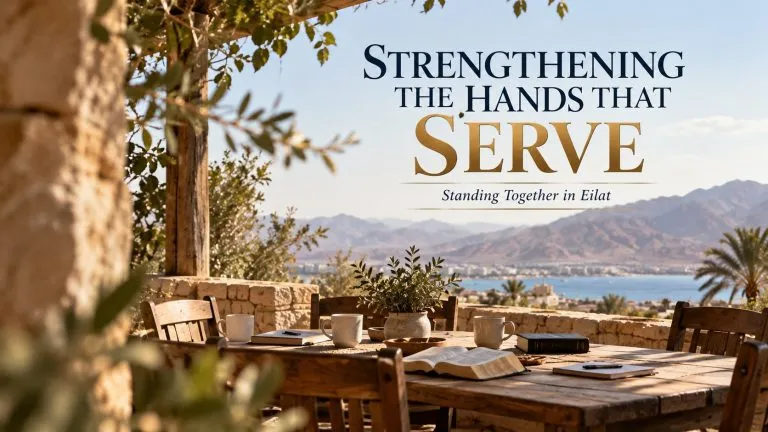
This week, Jewish and Arab believers are gathering in Eilat for a reconciliation conference that reflects a reality many people never get to see. In the midst of a complicated and painful season, brothers and sisters in Messiah are choosing to walk together, to listen to one another, and to stay committed to unity rooted in faith.
This gathering is not symbolic, theoretical, or political. It grows out of real relationships, shared experiences, and a common desire to follow Yeshua faithfully here in Israel.
“For He Himself is our peace, who has made the two one and has destroyed the barrier, the dividing wall of hostility.”
Ephesians 2:14
Reconciliation Is a Way of Life
Reconciliation is not easy, and it does not happen automatically. It requires humility, patience, forgiveness, and a willingness to keep showing up—especially during times of tension and uncertainty. Jewish and Arab believers carry different backgrounds, family histories, and experiences of pain, and those differences do not disappear when we come together.
Yet we are united by something deeper than our differences: our shared salvation in Yeshua the Messiah.
This is why reconciliation is possible. Not because circumstances are simple, but because Jesus changes hearts. No political solution or social idea can do that. Only the Messiah can reconcile us to God and teach us how to love one another in practical, honest ways.
“God… gave us the ministry of reconciliation.”
2 Corinthians 5:18
This conference, taking place this week in Eilat, is one small but meaningful expression of that calling, lived out through real relationships and shared leadership.
What This Looks Like in Practice
During the conference, Jewish and Arab leaders will worship together in Hebrew and Arabic. They will pray for one another, share meals, talk openly, and listen carefully to each other’s stories. These are not strangers meeting for the first time, but believers who are choosing to strengthen trust and friendship in a difficult season.
Young leaders—pastors, ministry workers, and worship leaders—are coming together not to debate identity, but to grow stronger in their identity in Messiah. Differences are not being denied, but placed under the lordship of Christ. Pain is not being ignored, but handled with care and grace. This is what unity looks like in real life—not perfection, but commitment.
“By this everyone will know that you are My disciples, if you love one another.”
John 13:35
Why This Matters Right Now
At a time when fear and anger spread quickly, the Church has an opportunity to model something different. This conference is not meant to respond to headlines or prove a point. It is meant to quietly bear witness to the power of the Gospel at work in everyday relationships.
It shows that Jews and Arabs can walk together without fear. It shows that young leaders can choose trust instead of suspicion. And it shows that the Gospel is not just a message we preach, but a life we are learning to live together.
“Blessed are the peacemakers, for they shall be called sons of God.”
Matthew 5:9
A Simple Invitation to Pray
As this conference takes place this week, we would be grateful for your prayers. Please pray for the Jewish and Arab leaders who are gathering that they would remain humble, courageous, and deeply rooted in Christ. Pray for protection over relationships that are being built carefully and honestly, and that the fruit of this time together would continue to grow long after everyone returns home.
Thank you for standing with us in prayer and encouragement. Your partnership means more than you know as we continue to walk out the ministry of reconciliation here in the Land.
All glory to Yeshua, who is our peace and our hope.