Evgeny had already done the hard part—or at least the part that looked hardest from the outside. He and his mother had managed to leave Ukraine during the war and make their way to Israel, something he still describes as a miracle. They were safe. They were living in Jerusalem. But arriving did not automatically make him feel settled, and one question kept following him into this new life: Why did I come here? It is an honest question when aliyah—the return of Jewish people to Israel—means much more than getting on a plane. There is a new language, unfamiliar systems, and the strange experience of trying to build an ordinary life after everything that came before.

Evgeny began coming to our gatherings, and during one of them he heard us speak about the Jewish people returning home to Israel and about God helping them as they begin again. He told us later that he received those words personally. They gave him another way to look at the question he had been carrying. Perhaps he had not simply been pushed from one country into another by a war. Perhaps there was a reason he was here, even if he couldn’t see much beyond the next step yet.
Then his mother suffered a stroke.
Whatever questions Evgeny had about his own future suddenly had to make room for a much more frightening one. Doctors were fighting to save his mother’s life, and somewhere in those days Evgeny reached for the Bible we had given him. He began reading it and praying. He called us too and asked us to pray for her healing. The doctors saved her life, and when Evgeny talks about what happened, he doesn’t speak as though medicine and faith are competing explanations. He is deeply thankful for the doctors—and he thanks God that his mother is still here. He thanks Him that they are in Israel. For a man who arrived carrying so many questions, gratitude has begun taking up more room.
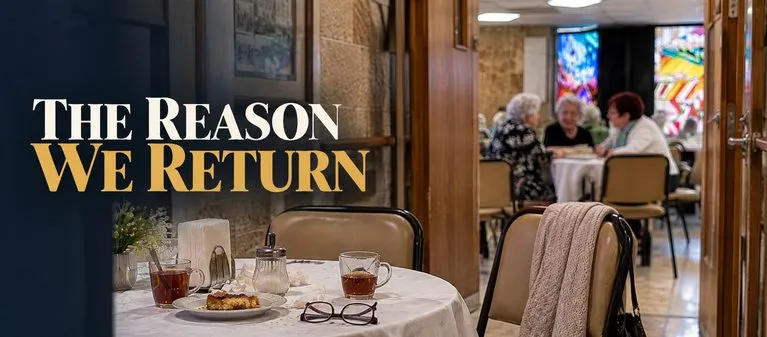
There has been another quieter change. Evgeny keeps coming back. He listens to the Word, asks for prayer, talks with people and says these gatherings help him keep moving forward. What he mentions especially is that he feels accepted. That word caught our attention because beginning again in another country can make even ordinary belonging feel precious. Someone knows your name when you walk in. People remember what you told them last time. There is somewhere to come back to. None of those things solves the enormous questions of life, but they can make a new place begin to feel a little less foreign.
And then, recently, on his way into the city, Evgeny gave us another prayer request.
“Pray for my future wife.”
That made us smile. He also asked us to pray that adapting to life in Israel would become easier, so no, all the difficulties have not disappeared. But listen to what has changed in that prayer. The man who used to wonder why he had come to Israel is now talking about a woman he hasn’t even met yet and a life he hopes to build here. His prayers are beginning to face forward.
Maybe that is why Evgeny’s story has stayed with us. There has been no neat moment when every question was answered. His mother went through a frightening medical crisis. Starting again in Israel is still starting again. But somewhere along the way, Why did I come here? has stopped being the only question. There is a Bible he opens now. There are people he can call for prayer. There is gratitude. There is even a future wife somewhere in those prayers. And in Jerusalem, the place Evgeny once wasn’t sure he belonged, he is beginning to imagine a life still ahead of him.
“For I know the thoughts that I think toward you, says the Lord, thoughts of peace and not of evil, to give you a future and a hope.”
Jeremiah 29:11